

FableVision Learning Spotlight Blog
Categories
- Animation-ish 42
- Books 21
- Civics! 2
- Classroom Spotlight 17
- Conferences and Events 20
- Creative Educator 3
- Creativity 25
- Distance Learning 13
- Dot Day 22
- FabClassroom 28
- FabFriday 19
- FabMaker Studio 66
- FabMaker Studio Classroom 13
- FableFive 7
- FableVision Games 3
- Free Educator Resources 36
- HUTCH 1
- Home Activities 5
- In the Classroom 34
- In the News 11
- International Dot Day 23
- Ish 1
- Library 1
- Mapping the World by Heart 7
- Paul Reynolds 10
- Peter H. Reynolds 54
- Professional Development 9
- STEM/STEAM 20
- Storybook Academy 2
- Teacher Spotlight 14
- The Dot 17
- The North Star 2
- Words and Their Stories 1
- Zoombinis 3

FABClassrooms Around the World: Part 2

Welcome to the continuation of our international FABClassroom adventure! This is the second of two blog posts highlighting the creativity of students using Fab@School Maker Studio in classrooms around the world to design, invent, and build their own geometric constructions and working machines - or anything else they can imagine. Take another peek at some more exciting projects below!

Burnham Brook School in Canterbury, NH

Students and educators at Burnham Brook School are both using Fab@School Maker Studio in creative and powerful ways. From sculptures in art class to paper masks for students who have dyslexia, Fab@School Maker Studio is empowering everyone to create bravely - even students who have a history of struggling with complex paper art projects. Kim Slayton of Burnham Brook School has even witnessed how Fab@School Maker Studio is empowering students first hand:
“I have a student who, due to birth complications, has only four fingers on one hand. This makes it especially difficult for her to use scissors. She was so excited and amazed when she came across the Fab@School Maker Studio program. She was able to plan and create a very complex paper art project without difficulty [and cut it out with the digital cutter]. It was a great “aha” experience when she finally saw her concept come to life."
Arrowwood Elementary in Highlands Ranch, CO
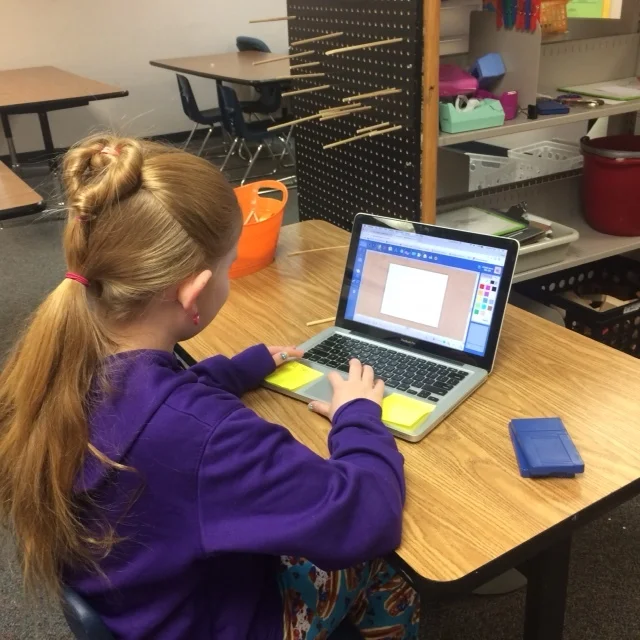
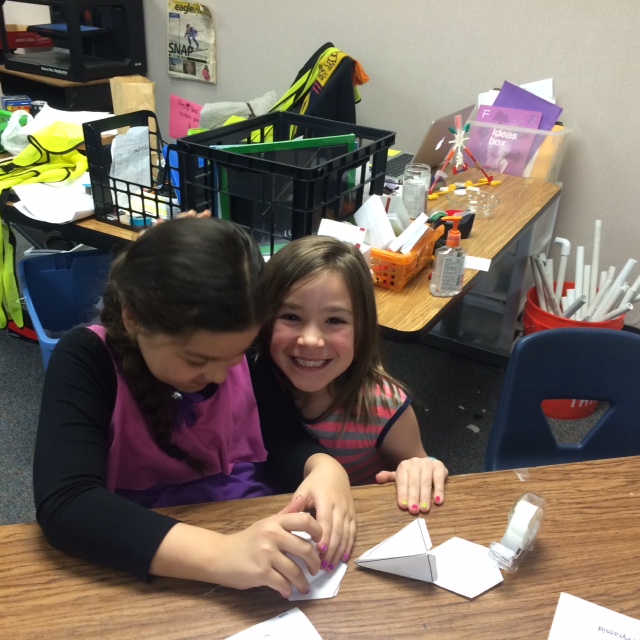
Arrowwood Elementary is a FABschool, applying and grappling with concepts creatively in order to deepen understanding. As part of this, the older students have been making prisms with Fab@School Maker Studio to be used as manipulatives by younger students, which reinforces both geometry concepts and school community!

Sir Charles Tupper School in Halifax, Nova Scotia
Laura Kennedy’s third grade students not only learned geometry and created bookmarks with Fab@School Maker Studio, but they also developed communication and collaboration skills and self-confidence along the way. Students loved creating projects and even expanded their learning with storytelling, poetry, and nonfiction facts about their design processes. To quote Ms. Kennedy, “Bookmarks might have been the task but confidence was the result.”


Wake County Public School System in Cary, NC
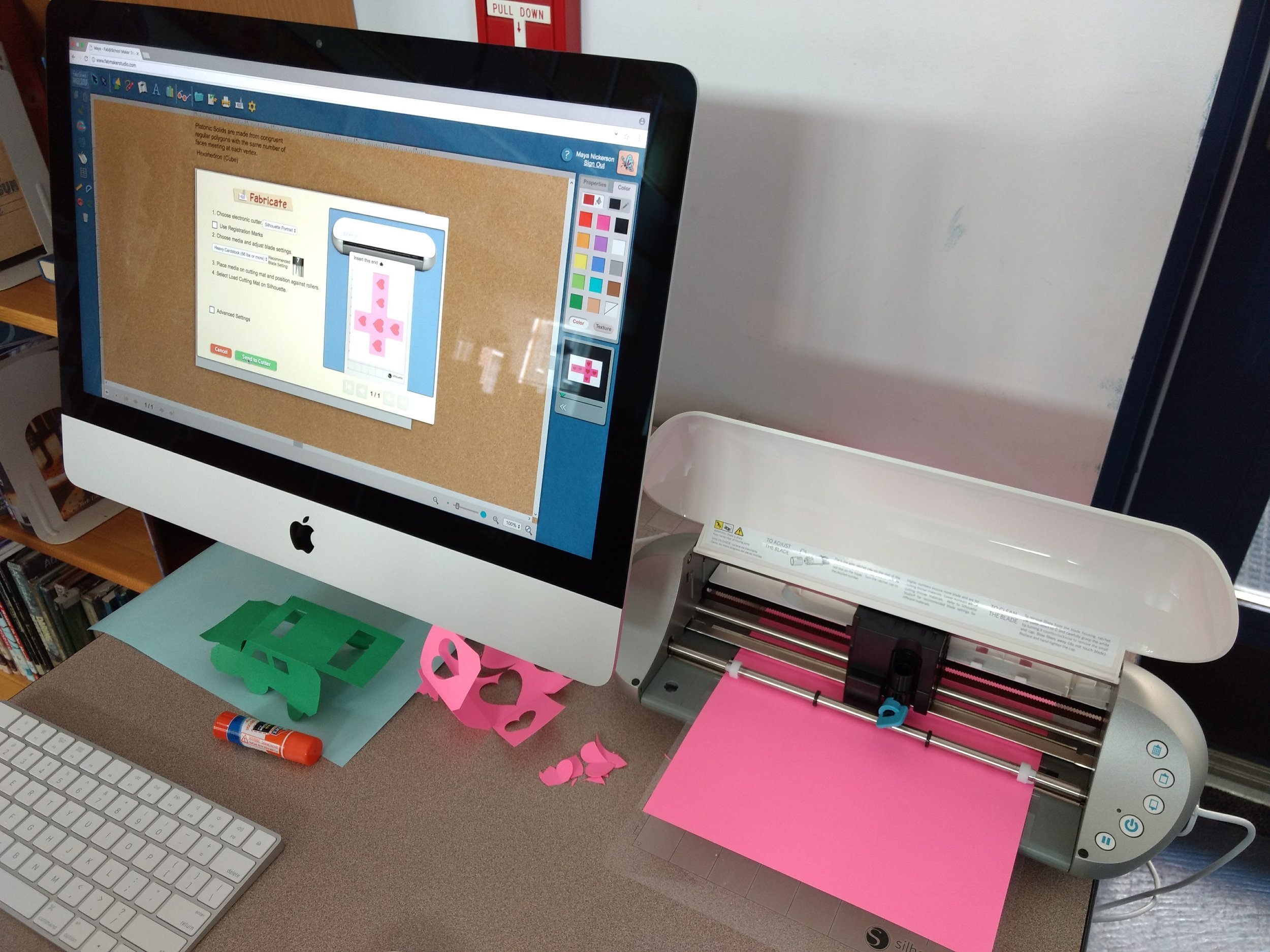
Wake County Public School System students have been busy making everything from story cubes to houses with Fab@School Maker Studio. Third graders have fabricated 3D story cube for writing and digital storytelling; other students created little houses to combine into town and city displays that demonstrate the difference between urban, suburban, and rural communities; and simply looking at pre-made projects with the 3D viewer in Fab@School Maker Studio has allowed students to better understand the difference between 2D and 3D. Even the principal joined in the fun one day with a bright orange crown that he fabricated and wore himself!


Salvation Army Boys & Girls Club of Yuma in Yuma, AZ
Lesson plans, display models, and curiosity abound at the Salvation Army Boys & Girls Club of Yuma, where Fab@School Maker Studio is so popular that two classes had to be established to meet demand! While many projects have been created so far, Program Director Tania Pavlak also noted that top spinners and a bee are two stand-out favorites.


Is your classroom a FabClassroom? We would love to feature your school in an blog post too! To be featured in an upcoming post, send an email to info@fablevisionlearning.com. You can also tweet your photos with the hashtag #FabMakerStudio! For more posts featuring Fab@School Maker Studio, click here.

FABClassrooms Around the World: Part 1

Fab@School Maker Studio is everywhere - from classrooms across the United States to classrooms across the globe in Canada and Saudi Arabia! Around the world, students of all ages are able to use Fab@School Maker Studio to design, invent, and build their own geometric constructions and working machines - or anything else they can imagine. In fact, there are so many creative FABClassrooms out there creating exciting projects that we had to make a two-part blog series to cover them all - take a look!

STEM Launch K-8 in Thornton, CO
Sixth graders used Fab@School Maker Studio to design tiny house models as part of their math Problem-Based Learning model, which allowed them to meet math standards while grappling with everyday problems. Students found Fab@School Maker Studio to be a perfect fit into their design process and had many positive things to say about working with it!
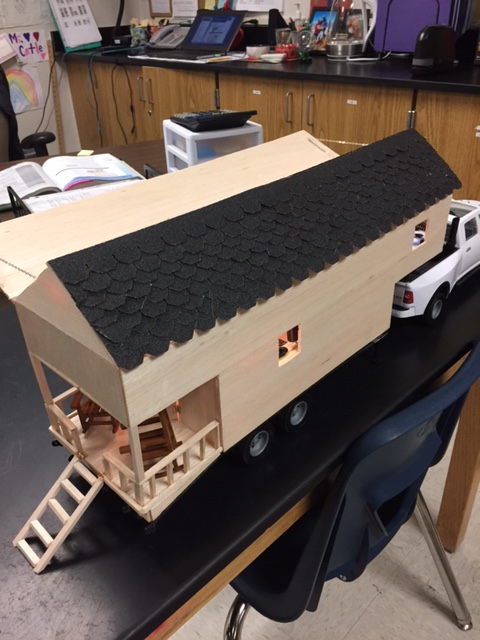
"FabMaker Studio is easy to use and understand. It's one of the best websites I've used for 3D printing! I love how if I needed a shape I could just grab it and move it. TinkerCad is too sensitive for me." — Logan S.
"This program helped us figure out the measurements and we determined how to scale it down by a third. We really liked the visual that the program gave us." — Eric D.
"I love the magnet tool. It really helped us construct our physical model." — Jeff D.


Boyden School in Walpole, MA
Karen Wolff’s first graders have used Fab@School School Maker to create snow forts and bees! The snow forts were made through experimenting with different types of shapes and prisms, both fabricated in Fab@School Maker Studio. Wolff’s students use the 3D viewer tool to see how different 3D cubes and rectangular prisms connect. The bees were fabricated as part of a lesson on honey bees that covered everything from the sounds in the word “honey” to the life cycle and anatomy of a honey bee!


International Schools Group Dammam in Dammam, Saudi Arabia

Digital Learning Coach Lorrie Cook is introducing students at International Schools Group Dammam to Imaginasium, the new and evolving STEAM lab. At Imaginasium, students are using Fab@School Maker Studio to create paper geometric constructions and working machines. According to Cook, students have clamored to create paper sculptures during their after school activities. One impressively savvy fourth grade girl even took the initiative to learn how to design with Fab@School Maker Studio all on her own!
Castle Rock Middle School in Castle Rock, CO

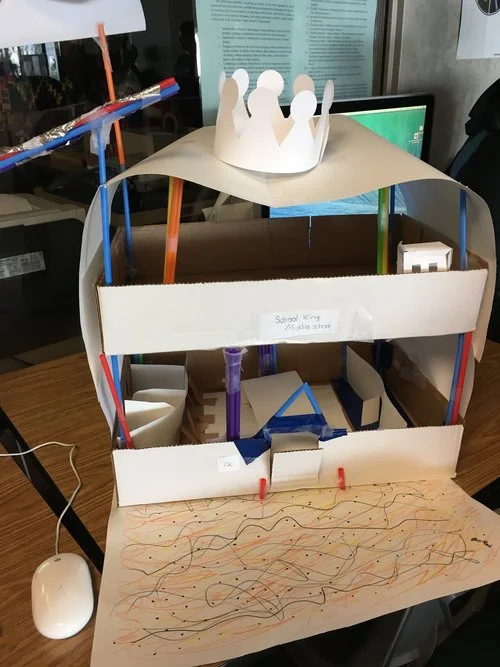
Students all across Castle Rock Middle School use Fab@School Maker Studio in classes ranging from World Cultures to Science. Eighth graders have designed tiny home interiors for a Sustainability Project, seventh graders have designed a school for a Mars Challenge, and World Cultures students have learned about Japanese culture and paper folding with Fab@School Maker Studio. School librarian Yvonne Miller says that, “The spatial awareness and critical thinking necessary to design a 3D project is challenging to say the least” and that when students use Fab@School Maker Studio “there is definitely a lot of metacognition and visible thinking going on.”


PROJECT EXTRA in Oceanside, NY
PROJECT EXTRA are excited to use Fab@School Maker Studio to participate in their annual Invention Convention at their local library in May. According to Angela Maria Abend, a teacher at PROJECT EXTRA, “This event is held annually and is attended by hundreds of people who share and celebrate the students' creative journey of innovation. Having this equipment in the classroom this year is a definite game changer!”

Is your classroom a FabClassroom? We would love to feature your school in an blog post too! To be featured in an upcoming post, send an email to info@fablevisionlearning.com. You can also tweet your photos with the hashtag #FabMakerStudio! For more posts featuring Fab@School Maker Studio, click here.

Classroom Spotlight: Dreaming with Peter H. Reynolds

Fourth Graders from the Rectory School in Pomfret, CT, recently spent a day with Peter H. Reynolds in his bookstore, The Blue Bunny. The following post was written by Maria Carpenter
Connecting our students with experts that extend their learning, and broaden their experience is a goal that we strive for, each day at Rectory School. On Friday, April 6th, Melissa Zahansky and I had the distinct pleasure of accompanying our grade four students to visit the children's book author/illustrator Peter H. Reynolds in his bookstore, The Blue Bunny in Dedham, MA. The K-4 community used Peter's books to create art experiences for the children to explore for our school's first ever MELP, Jr. ES Artists in Residence. We knew that we were in for a treat, but as we left the bookstore that morning, we all felt that we had just participated in a once in a lifetime kind of experience! Peter H. (for Hamilton) Reynolds is an extraordinarily kind, creative and generous human being!

Peter grew up in Dedham, MA and told the children stories of how he always loved to collect words and draw, ever since he was a child. He has a twin brother, Paul, who is his friend and creative partner at FableVision Learning, a company located above the Children's Museum in Boston, MA. FableVision Learning provides support for educators around the world to nurture the 4 C's (plus 1): creativity, communication, collaboration, critical thinking - and compassion both in and out of the classroom. We heard detailed stories about Peter's own creative process, and he encouraged our children to collect words that are interesting to them, as well as their dreams and ideas in a journal.
We heard about the real girl who entered the book store one day selling carnations for her school, named Vashti, who quietly watched Peter sketch over his shoulder. She became the lead character in his award winning book, The Dot, which has received many honors, is translated into several languages, and has even traveled to the space station! The Dot reminds us all to "Make your mark, and see where it takes you."
Giving our students the opportunity to dream about the journeys that they may strive for in their lives is of great importance to all of us at Rectory School. Our morning with Peter, will linger in our minds for a long time. He taught us about goodness, reaching out to those around us who need a helping hand, and being our best selves. Thanks Peter, for being such a light for our students... and creating such magical picture books that make the world a more compassionate place!
These are the memories that our Grade 4 students would like to share about their visit:
"I have never had an author read a book to me! I loved when he read The Word Collector!" ~ Ashley
"I loved when Peter Reynolds was talking about my future... maybe he will be right, and I will work in the White House!" ~ Alexandra
"I liked it when Peter Reynolds found out I was a good speller and loved words. He offered me a job when I get out of college... the funny thing is, he was serious!" ~ Lilah
"I loved that he listened to our ideas when he was drawing a picture of Vashti." ~ Isabel
"I liked it when he asked us to think about what the world needs more of or less of, so he could get ideas for his next book." ~ Sean
"I loved hearing him talk about himself. You don't get to hear an author do that everyday!" ~ Anson
"I love seeing The Dot book that actually went into space, and hearing the story about how the commander called him from the space station!" ~ Peter
"I like that he always has a twist that gets fixed in his books." ~ William


Avon Public School Brings Home Award for Their Choral Reading of The Word Collector
Jennifer Yantzi teaches at Avon Public School in Ontario, Canada. Sixth graders at the school recently took home first place in the Kiwanis Festival of the Performing Arts - Stratford for their choral reading of "The Word Collector" by Peter H. Reynolds.

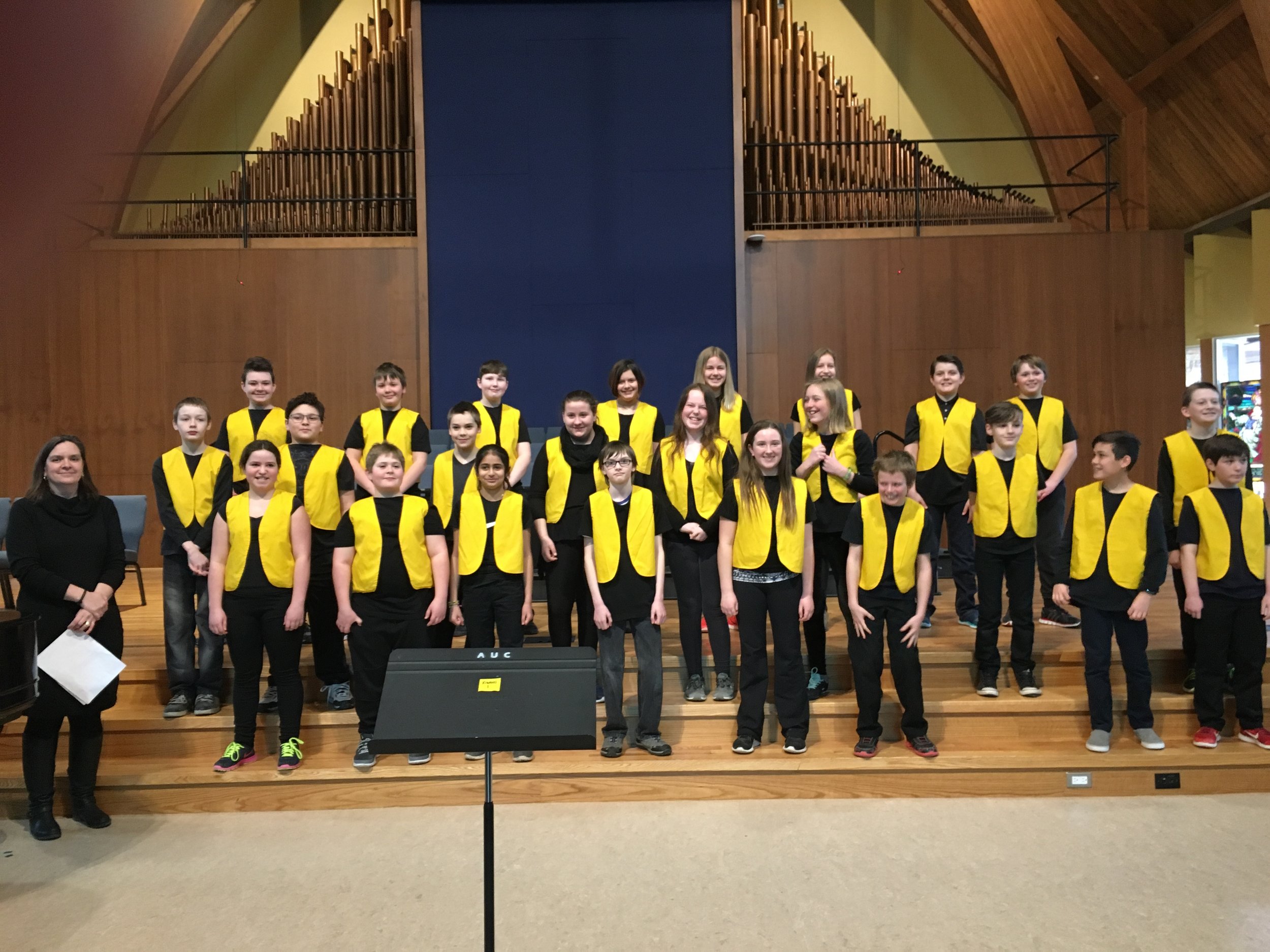

Jennifer shares: “We had the opportunity to go to the Kiwanis Festival of the Performing Arts - Stratford. Our part of the Kiwanis Festival was choral speaking Grade 6. We could pick a poem, song or book to present and compete against other classes and schools. We chose “The Word Collector,” because of the impact of the story combined with a musical quality. It took us about four weeks to figure out how we were going to say certain words, assign parts, memorize the book and then practice presenting the poem. Like Jerome, we collected many words and would enjoy sharing them with the world.”

Classroom Spotlight: Animation-ish, Integrity, Resiliency, & Perseverance A Lesson in Creativity and Life
This Animation-ish Spotlight was written by Robin Corbeil, a teacher at Litchfield Middle School.

How can we use technology skills to inspire the people around us to be better? This is a question I have asked myself for many years as a computer/technology teacher. One Answer: By encouraging and inspiring our students to take a risk and create something with the ISH philosophy. I challenged my students to become better people by connecting the themes of Resiliency, Perseverance, and Integrity to their lives in an “ISH” way. We hope you enjoy and learn from our Animation-ishes.


More about Me
I have been a computer teacher and technology support staff at Litchfield Middle School in Litchfield, NH for the past 14 ½ years. I was inspired when I first saw Peter H. Reynolds and the Animation-ish software while attending a technology conference in 2009. I knew this was a tool I could use to unlock the creativity of my students.
I loved the “ISH” approach of encouraging students and teachers to take risks and embrace the time needed to explore their creative sides. I introduce my Animation-ish lessons by modeling for my students, my limited animation abilities, with the famous line “it is tiger-ish” and that is ok. This little statement empowers my students to create their own ISH drawings and animations. My students always look forward to the use of Animation-ish as much as I do. These lessons are amazing because of how engaged the students are in creating and exploring their new skills and talents as well as furthering their understanding of various concepts.
My Plan
My use of Animation-ish in the past include, Internet safety, anti-bullying, reflection on learning experiences in other content areas, and Public Service Announcements.
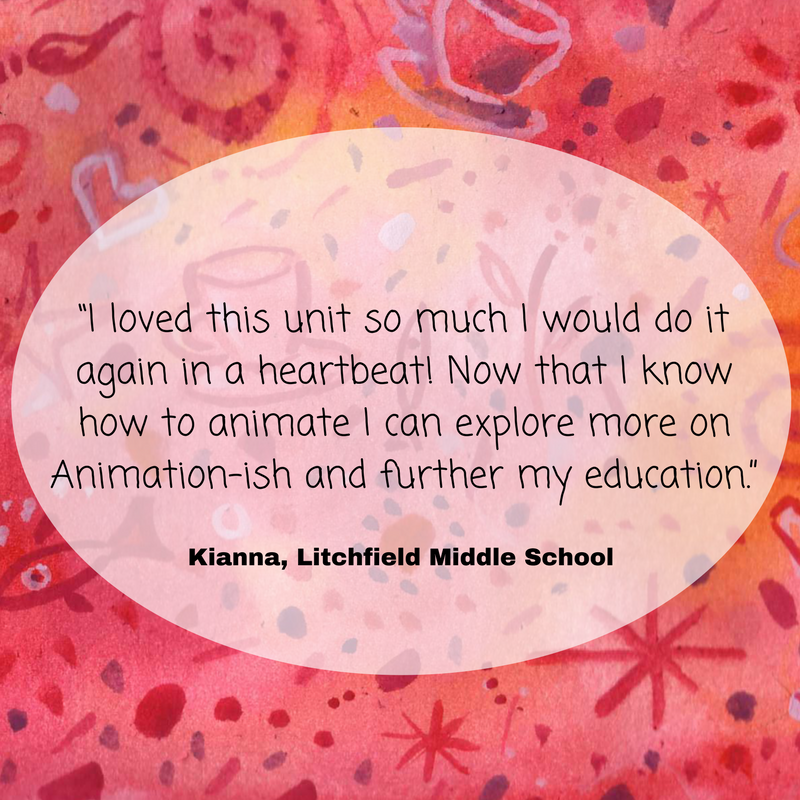
This year was different because I had the chance use technology to help my students become better people through the use of technology. Our PBIS team’s, Positive Behavior Intervention Supports, focus is on expanding students understanding of Integrity, Resiliency, & Perseverance. Animation-ish was the perfect tool to really engage and connect students to these very important concepts. Students were given presentations in small groups defining and identifying what these types of qualities would look like in the students lives. It was easy to see these were important concepts in not only educating my students but, in helping them to become the best people they could be.
When introducing this project I reviewed animation skills students acquired last year using Flipbook-ish to establish and reinforce the skills they would need to bring their text to life. This was followed by a week of developing Advanced-ish skills, giving them options for their animation. Once my students had the necessary skills needed they reviewed the presentations and choose any still image/saying on Resiliency, Integrity, or Perseverance, they connected with for their Animation-ish project. The goal was to give the image/saying more meaning and develop a deeper understanding for themselves and other students. This process allowed me time to check in with each student and have really interesting conversations about their vision and help them focus their animation. Students were also allowed to come up with their own example if they choose to. If students were having trouble getting started I would ask them to tell me “What main topic their saying came from, Integrity, Resiliency, or Perseverance?” and them I would ask “What do you love to do?” and “What does that topic, Example Integrity, look like in that area?” These questions lead to great discussions with students and a deep understanding and connection to these real life concepts.
Once students understood what they wanted to animate I modeled an animation by choosing the phrase “Bend Don’t Break” using a fishing pole-ish, that when it caught a fish-ish, that was labeled bad grade, that the fishing pole would bend but not break. I stressed that my animation was not perfect and continued to evolve everyday into a better version. I often asked students their thoughts and opinions on my animation to encourage them to share with me as well as others. We were fortunate enough to have various staff members join our class to help students develop their animations. This was important because it showed students that I didn’t always have the answers or only perspective that mattered. They were encouraged to explain their vision/animation until it no longer needed an explanation. Once their animation could stand on its own and convey the message they wanted heard it was done-ISH. I hope you have enjoyed my students work!




FABClassroom: “Fab” ulous Cars

For this week's FabClassroom we head over to Augustine F. Maloney Elementary in Blackstone, MA. Monica Carty is an elementary technology teacher at Blackstone-Millville Regional School District. She has been using Fab@School Maker Studio in her after school STEM club. It has been so successful she will be launching an after-school club just for Fab@School! Monica shares how her students used FabMaker Studio to design some "Fab" ulous Cars!

Who says learning has to be dry or boring? Or even end with the school bell? Well I do not think that ever has to be the case! In fact, I run an amazing STEM club after school thanks to my school parent organization and Fab@School Maker Studio that say different.
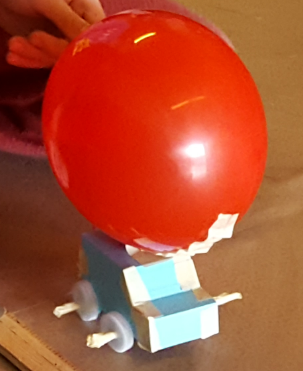
In the past my STEM clubs were always enjoyed by all the students who attended, but this year I stepped it up by adding the use of Fab@School Maker Studio. In the club’s conclusion project students designed, developed, and created balloon powered cars. Students had a wide range of tools and supplies at their disposal. The only requirement was the car had to move by balloon power!
Students quickly went to work developing a sketch, or basic blueprint, and a supply list. From their printing, cutting and building noises filled the room with laughter and smiles. When testing day came no one was nervous because at that point they felt that failure was their learning opportunity.
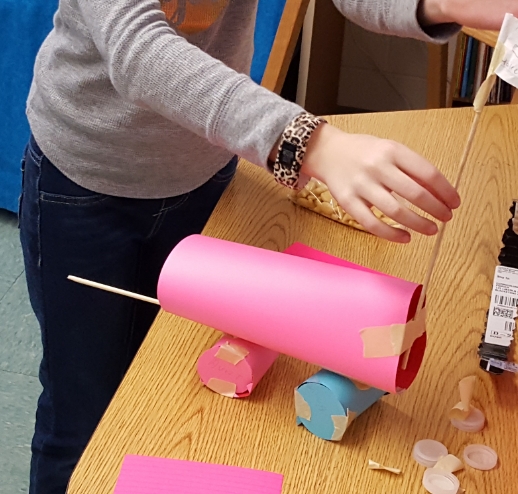
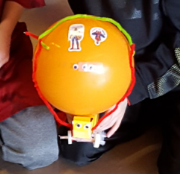
I highly recommend trying this with your students as you explore several science and engineering standards in your classrooms. If you want to connect to multiple subject areas you can have students do a formal write piece about their experience, or develop a descriptive writing piece for their design. If you are looking to integrate more math calculate distances, movement times, or building expensives is a great option. The fact of the matter the possibilities are only limited by your own creativity!
Is your classroom a FabClassroom? We would love to feature your school! To be featured in an upcoming post, send an email to info@fablevisionlearning.com. You can also tweet your photos with the hashtag #FabMakerStudio! For more posts featuring Fab@School Maker Studio, click here.

Peter H. Reynolds Honored with Prestigious 2018 Children’s Literature Award

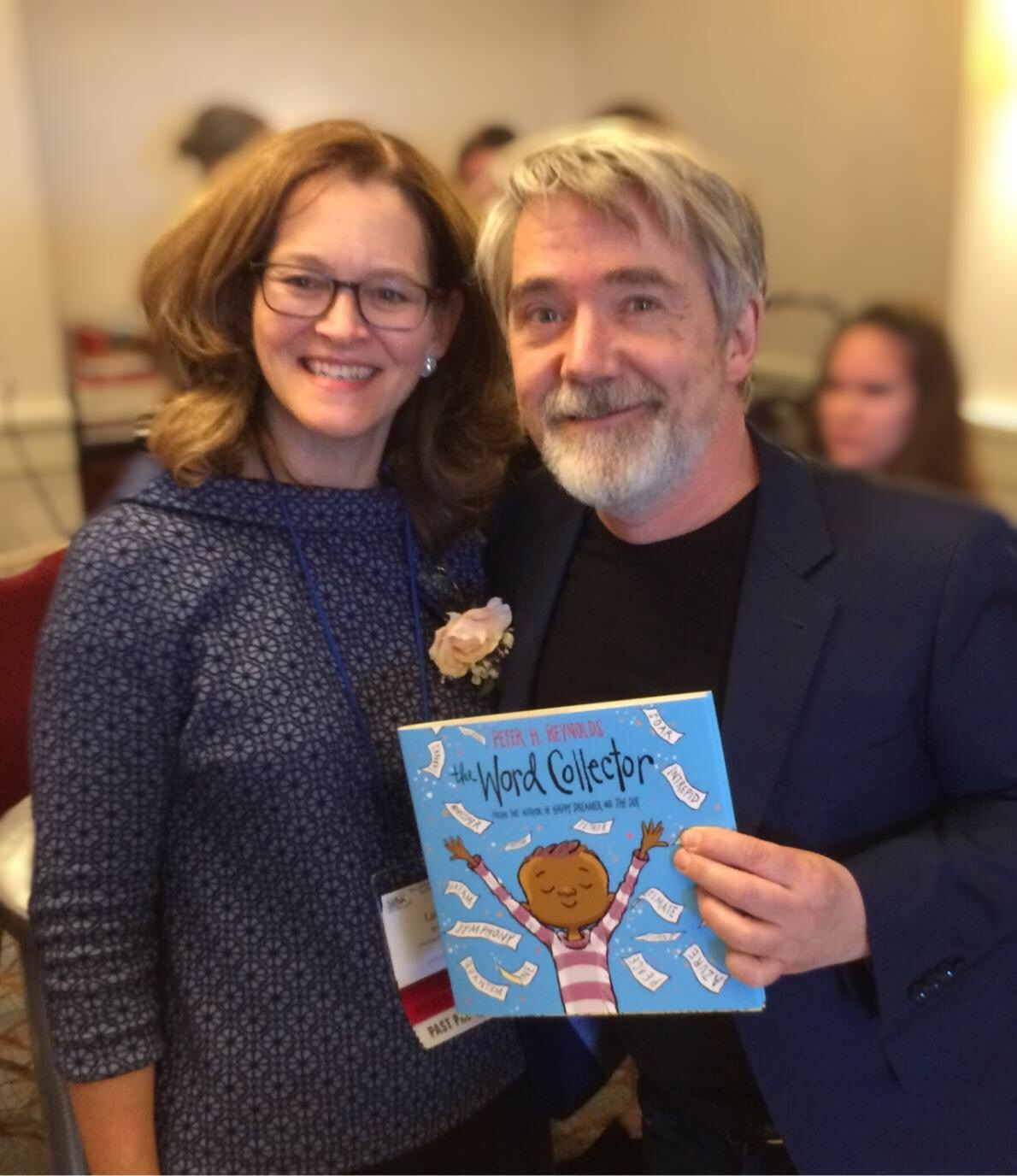
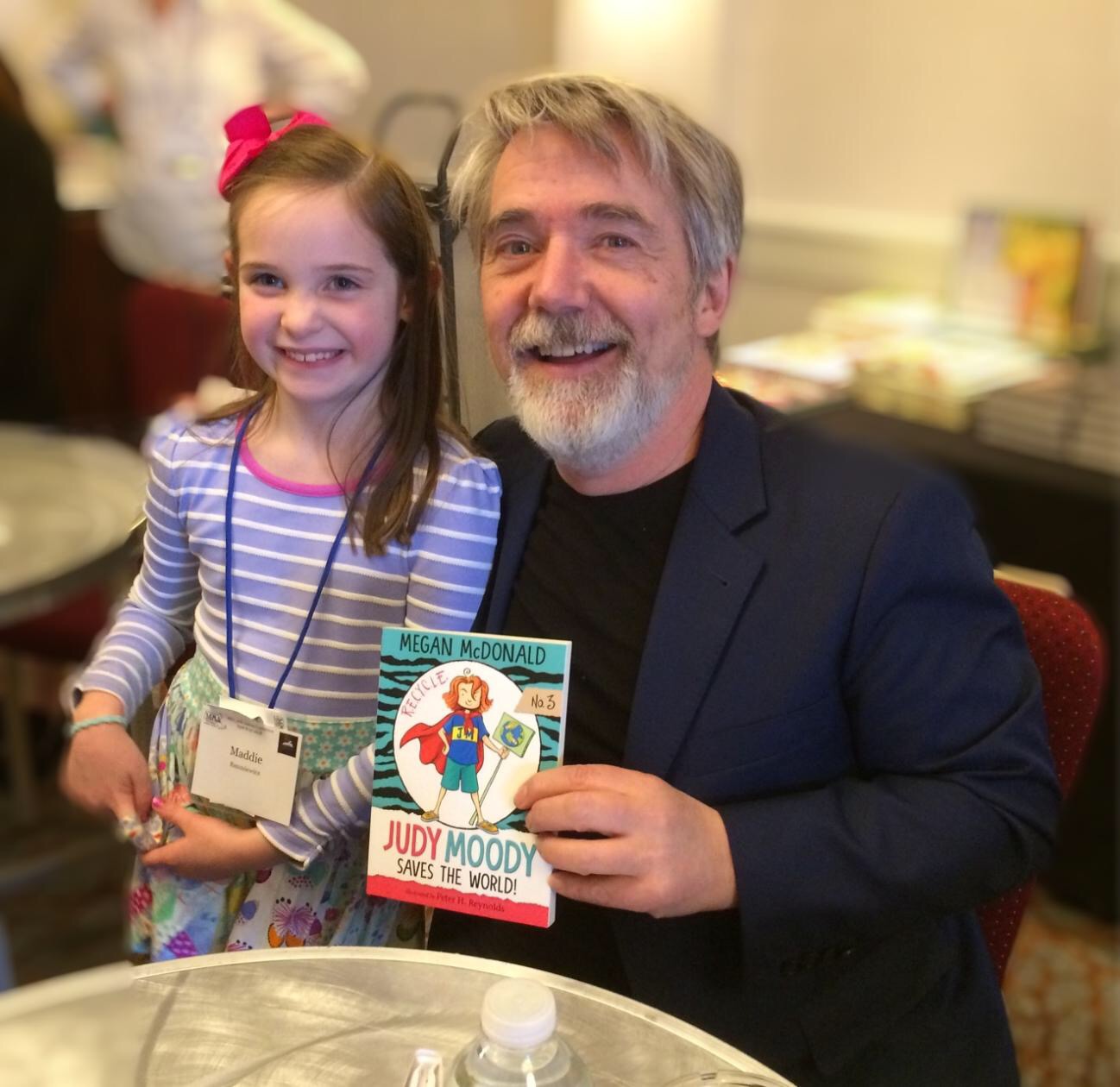
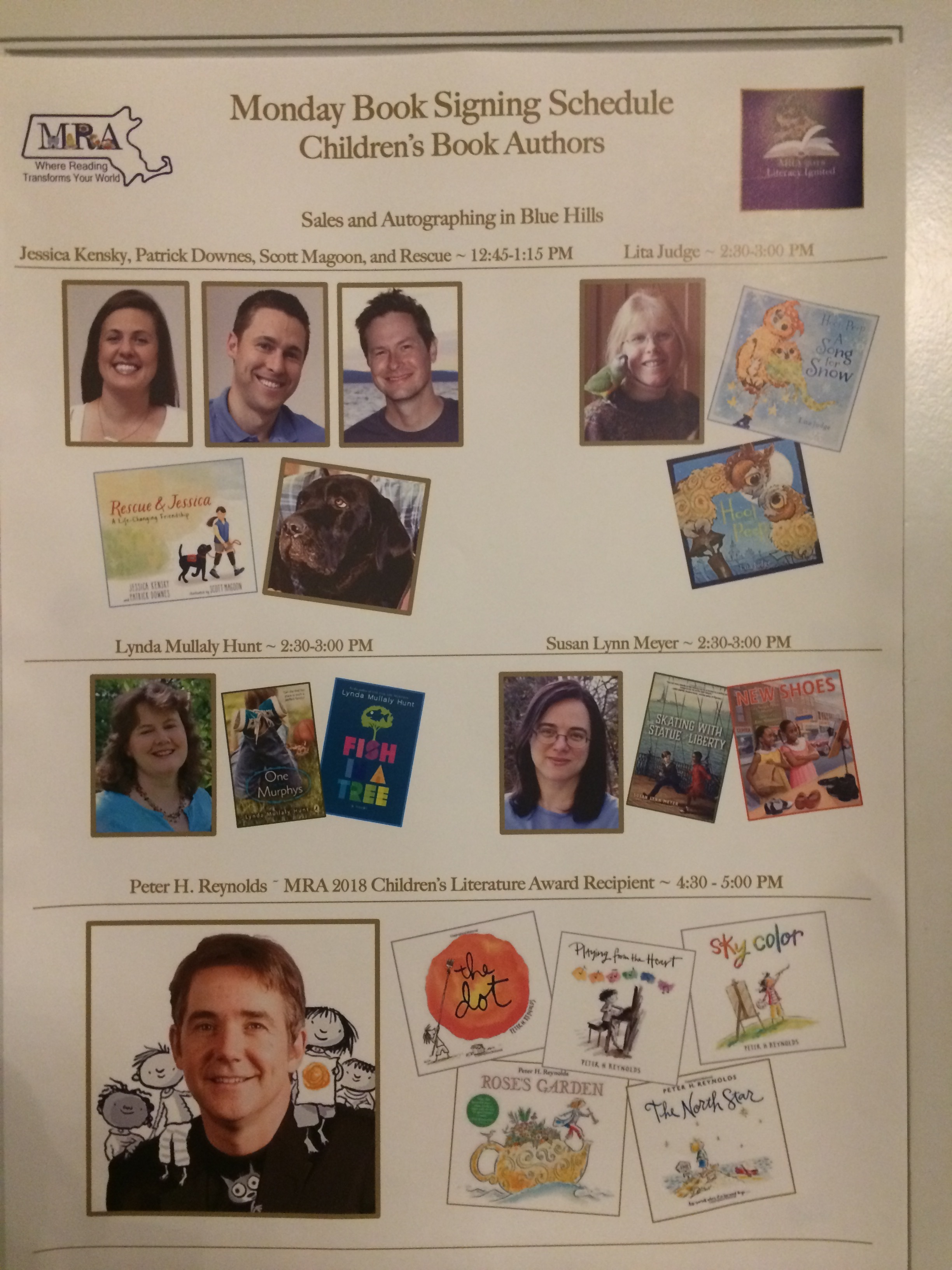
FableVision founder and New York Times bestselling author/illustrator Peter H. Reynolds was honored on Monday, April 9, with the 2018 Children’s Literature Award from the Massachusetts Reading Association (MRA).
The association remarked that Reynolds' "complete works have made a substantial and lasting contribution to literature for children” and recognizing his "reputation for writing books about protecting and nurturing the creative spirit.”
Reynolds joins the ranks of previous children’s literature luminaries, which include Marc Brown, Rosemary Wells, Patricia MacLachlan, Jane Yolen, Tomie DePaola, Laura Vaccaro Seeger, Lois Lowry, Katherine Paterson, and the Pinkney family.
After Reynolds received the award from the MRA leadership team, he presented a keynote called "The Courage to Create and Make One’s Mark” to hundreds of educators, who gave him a standing ovation. Reynolds shared how lucky he feels that teachers, librarians and students around the work have embraced his stories about creativity, courage, and compassion - and have put the ideas into action.
Reynolds shares, “When I read my books about creativity to kids in school I will always follow up with discussions about creativity and I often refer to it as a “superpower” they all possess - which, if not used on a regular basis, will disappear from their grasp. It elicits some great gasps from the audience and of course, I am there encourage them NOT to let go of it."
The Massachusetts Reading Association is a professional non-profit organization whose primary purpose is to improve the quality and level of literacy in the state of Massachusetts. The MRA is affiliated with the International Literacy Association (ILA), a worldwide literacy organization with a network of 300,000 educators in 99 countries. The MRA promotes literacy for all learners through professional development, research, publications, and advocacy for the literacy community.
Reynolds books have been translated into more than 25 languages around the globe and are celebrated worldwide. They include the best-selling “Judy Moody” and “Stink” series, “The North Star”, “The Dot”, “Ish”, “Sky Color”, “I Am Peace”, “Someday”, and most recently “The Word Collector”, which hit the New York Times Best Seller List at position #4.


Explore Math with a Valentine’s Day Explosion Box!
This post was written by Peggy Healy Stearns, Ph.D., the designer of Fab@School Maker Studio and co-founder of the Fab@School coalition.
If you love pop-ups – those playful, joyful constructions that bring books and cards to life – then you’ll probably love “explosion boxes.” These popular 3D paper crafts take pop-ups to a whole new dimension.
Like pop-ups, “explosion boxes” offer an engaging way to invite students into the world of math and engineering. They encourage students to explore and work with measurement, parallel and perpendicular lines, angles, triangles, symmetry, and transformational geometry, all in the context of engaging manipulatives kids design and make themselves.
Although the deepest learning comes when students design from scratch, a Fab@School Maker Studio Ready-Made Project jumpstarts students by providing a model they can explore and customize. Once students understand the shapes, cuts, folds, and angles that make up an explosion box, they are better able to design from scratch.

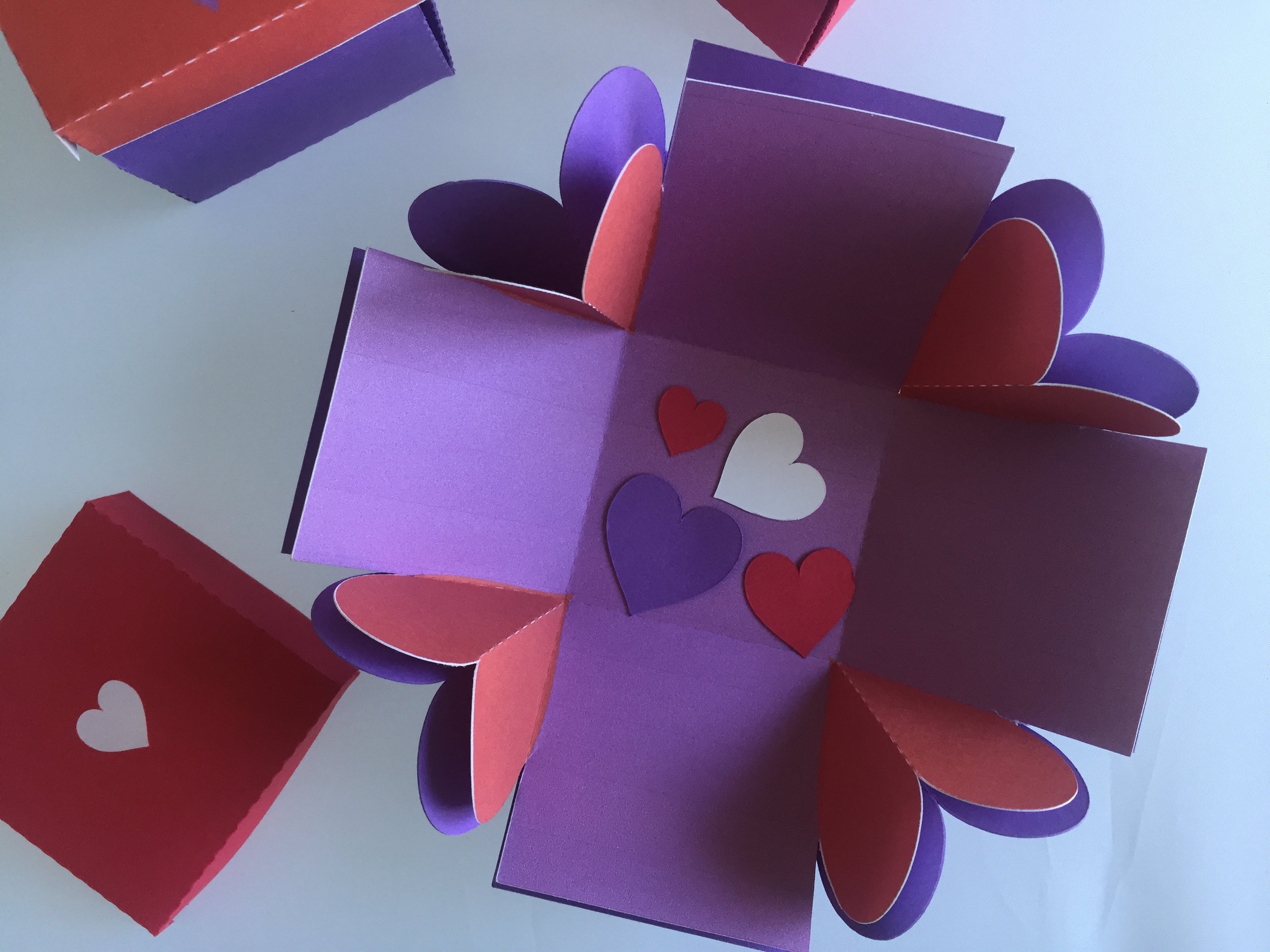
The simple explosion box shown here is designed to enclose a small Valentine’s Day treat, gift, or note. It can be printed first and then cut, or cut without printing from colored card stock or plain white paper that students decorate themselves.
Encourage students to customize with color, cutouts, and other design elements. Once students have their initial model in hand, ask them to explore their constructions. Use some of the questions below to kickstart a class discussion. Then challenge students to design their own original explosion boxes.
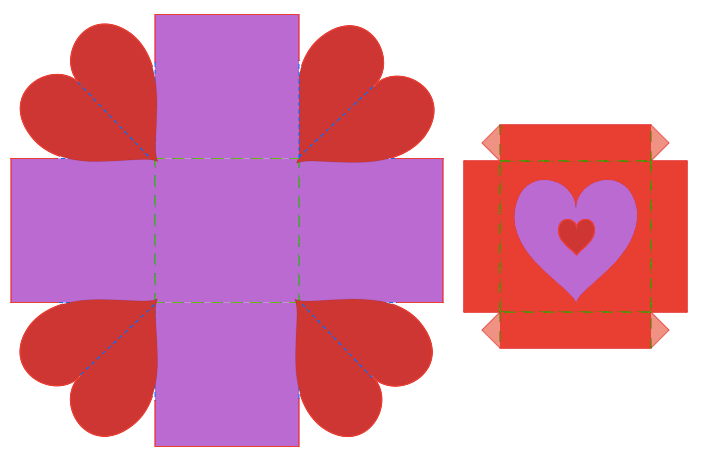
Above, is the template for the Fab@School Explosion Box Ready-Made. Check it out!
Explore the explosion box:
- How many faces does your explosion box pattern have? How do you get 9 faces to fold into a square box?
- What will fit inside the box?
- What is the volume of the box? How many M&M’s, plastic counters, or marbles will fit?
- At what angle do the square sides fold? At what angle do the hearts fold?
- Can you suggest other shapes or images that would work in place of the hearts?
- What do you like best about your explosion box? What would you like to change?
Challenge:
- Design 2D, pop-up, or 3D elements scaled to fit inside your explosion box.
- Can you resize the box to hold a different object?
- Design an original explosion box from scratch for Valentine’s Day or another occasion. Search “explosion box” on the Internet for ideas.
- Make a different shaped explosion box. Can you design a box that looks like a building, animal or other object? With a specific purpose or “client” in mind, set criteria and constraints and design a box that meets these guidelines.
Common Core Math Standards [Additional standards apply.]
- CCSS.MATH.CONTENT.K.MD.A.1
- CCSS.MATH.CONTENT.1.G.A.2
- CCSS.MATH.CONTENT.2.G.A.1
- CCSS.MATH.CONTENT.3.MD.C.5
- CCSS.MATH.CONTENT.4.G.A.3
- CCSS.MATH.CONTENT.5.MD.C.3
- CCSS.MATH.CONTENT.6.G.A.2
- CCSS.MATH.CONTENT.7.G.B.4
Next Generation Science Standards
Classroom Spotlight: Tudor Elementary Connects the Dots on Dot Day
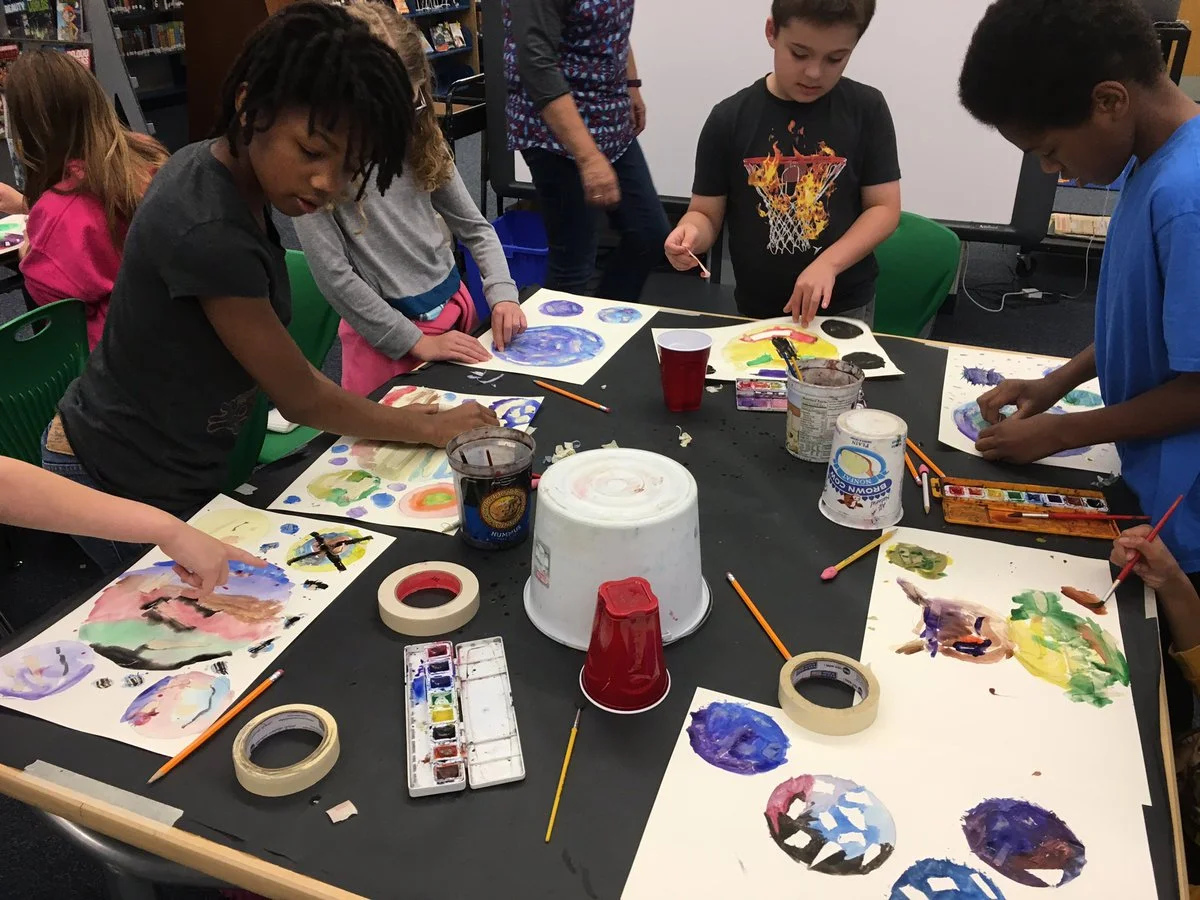
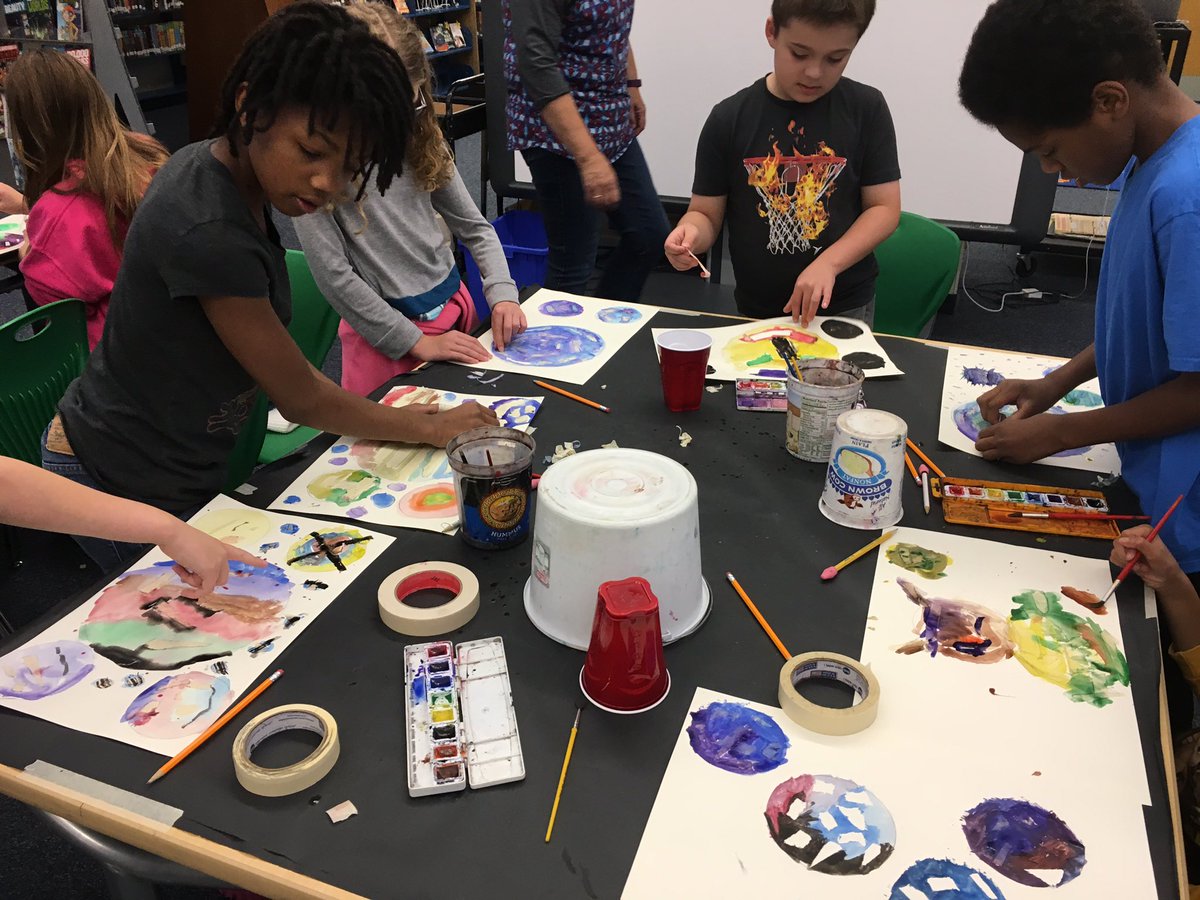
Michelle Carton is an accomplished global educator and librarian at Tudor Elementary School in Anchorage, Alaska. She is known for her innovative curriculum and has taught in many diverse school environments, but her deep passion for making education relevant and empowering for students while building a lifelong love for learning and exploring has remained a constant. To celebrate International Dot Day, 2017 Michelle and her class connected the dots around the world - so we connected with her to learn more about how she inspires students every day to make their mark!
How did you first learn about Dot Day?
We first learned about Dot Day when I was searching out global and international activities for students. Our first year, we simply read the book, talked about international and global activities. We then created our dots. Our next year, we took it further to talk about how we will make our mark on the world, and why that matters. This year, we took it global and connected with schools all over the world, from Pakistan to Sri Lanka, Canada, and the "lower 48," connected it to the UN Sustainable Development Goals and shared how we will make an impact on being good earth citizens and taking care of each other and the planet.
How does Dot Day tie into your work as a global educator and the mission of Global Education Alaska?
Global Education Alaska initially started out through my Fellowship, Teachers for Global Classrooms sponsored by the U.S. State Department and the International Resources and Exchanges Board. It has now become an opportunity for teachers all over the world to find ideas and resources to take their class global, through workshops, seminars, and simply perusing our website. As a teacher in Alaska, I know our students come from all over the world (we have one the most diverse districts in the country), to a place that is quite isolated and remote, they just need a platform to embrace the world's people, lives, and stories, in a way that will help them embrace their own.
Dot Day is an opportunity for young people to celebrate their marks on a global scale. By connecting with schools around the world, we are making global citizenship more attainable and realizing that young people, no matter where they live, innately want to do good and be a part of the solution. Dot Day does a great job of setting the foundation for International Day of Peace and also United Nations Day, where we delve further into the idea that we are all connected and by learning about the world, understanding the perspectives in the world, and connecting with the world, we are in deed "taking action" which is what it means to be a global citizen. Global Education Alaska provides an opportunity for Alaskan students to learn about the world and for the world to learn about Alaska, the real Alaska (not the one on television).

Do you have tips for educators looking to take their Dot Day celebrations global?
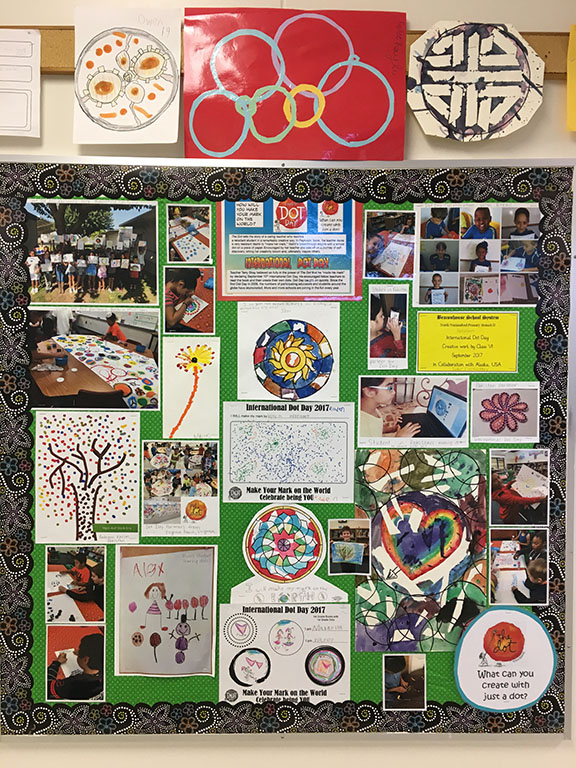
Taking your Dot Day global can be easy, mostly because I have laid out on our website, just how to do that! Also, a few things I learned along the way. Using a tool such as signup.com, makes managing a calendar really simple. Also, making sure to double check a few days before, as we are busy educators, really helps solidify the process. Having students set goals for connecting creates a strong sense of buy-in as well.
My students' goal for next year is to connect both with Emily Arrow to learn the Dot Day song and the team at FableVision to share how they are making their mark on the world AND how they intend to do that in their future as well. What is being done through Dot Day many do not realize: for students to have a voice and see it be heard and honored builds an incredible foundation for growth, both academic, personal/social.
What is your favorite memory from your Dot Day 2017 celebration?
My favorite moment from Dot Day 2017 is when my students who normally are quite disengaged, shy, or overwhelmed by their life outside of school, get incredibly excited, and truly become children again, to laugh, and clap, and remember. Students all year will tell me, "Remember when we connected with _____ for Dot Day, that was really cool." They will remember these moments, all the way into their adulthood. For children to be able to have something to grab onto, even in the most challenging times, is incredibly precious!
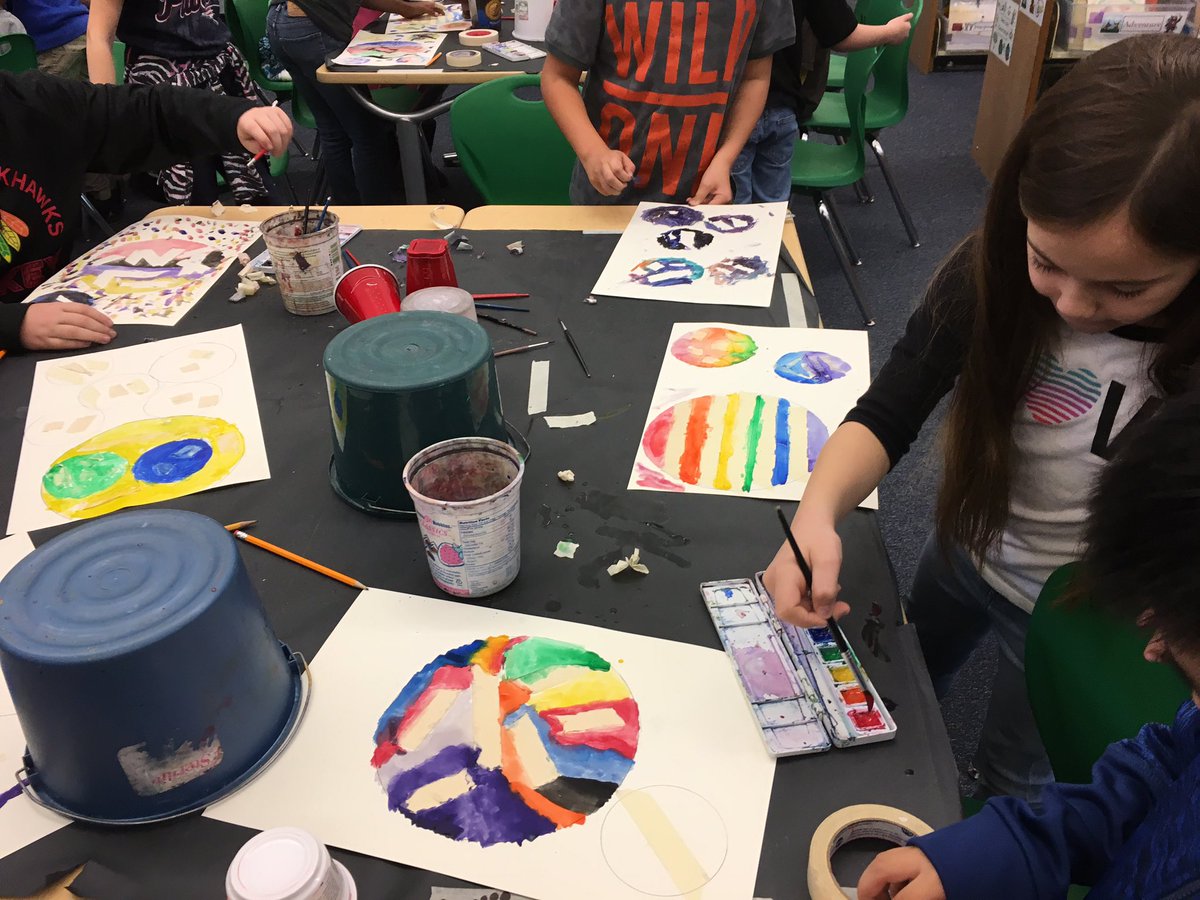
How do you inspire students to make their mark and what’s your own inspiration?
Inspiring students to make their mark, care about the world around them, and a desire to be a part of the solution, comes from my own passion for these things. Students want to be engaged and excited; when an educator is, and gently guides students to take suit, they are carving a lane for students to be vulnerable. My own passion comes from being that kid who didn't really engage, teachers just pushed on, struggled in school, went to 9 different elementary schools, was in an out of foster care, and didn't really have something to be passionate about. I had one teacher, in 4th grade, who reached out in a major way and it changed my life. I aim to reach that student, and along the way, bring with me lots of other excitable young people.
I left Corporate America to do something I believed could make an impact on the world, and I haven't stopped yet. Now, I have 350 developing young global citizens who are beginning to see the impact of their dedication and passion. To be a global citizen is to embrace the possible, push past the maybe, and explore the unknown--but to always come out in a much more aware state of being. We are building future peace leaders, one dot at a time.

How did you Make Your Mark on Dot Day?
We love seeing all the Dot activity on social media! Share your Dot Day celebration and tips by using #DotDay and #MakeYourMark.
If you would like to be featured on the FableVision Learning blog, send us a message: info@fablevisionlearning.com.

Getting "Messy" with Fab@School at the ED Games Expo
In a room filled with amazing virtual reality stations, impressive mobile apps, and science simulations, we were the “messy table.”
On Monday, Jan. 8, FableVision Learning joined hundreds of game developers at 5th annual ED Games Expo hosted by the U.S. Department of Education at the The John F. Kennedy Center for the Performing Arts in DC. The expo was a chance to showcase learning games developed through The Small Business Innovation Research (SBIR) program to students from the DC area.
We discovered that in this digital age, youngsters were drawn the tangible. Our table was the busiest of all! Why? We were there to demo Fab@School Maker Studio, an online tool where students design with 2D shapes to create nets that when fabricated using a digital cutter become 3D objects.
The perk - it is all done with paper.
I was inundated with students all lining up to answer one simple question: “What do you want to make”? Everytime the answer was different.
- “What do you mean… make?”
- “A house.”
- “A car.”
- “A Mickey Mouse face that has stars instead of circles for ears”
- “What can I make?”
- “I want what she made, only different.”
The challenge was on and it was only 10 a.m.
Students picked a piece of colored cardstock, mounted it on a sticky mat, and patiently waited for their turn.
A fourth-grade girl was excited to create a dodecahedron - she just loves shapes. But wanted two sides to have a cut-out of a star. This was simple - by dragging a star from the shapes pallet onto her design she was able to see her idea come to fruition digitally and after 50 seconds though the digital cutter - she was folding her geometric shape.
One girl wasn’t impressed with the sunglasses she was wearing and wanted to create her own. As a group of young engineers we examined what shapes were used in the construction of the glasses.
“Maybe two circles with two more circles in the middle to see,” one student suggested.
“Now we need a rectangle to make them connected,” another added.
At the end of the design phase, we had a pretty nifty pair of sunglasses with very long arms. Back in Fab@School, she used the ruler tool to accurately create the perfect pair of sunglasses.
There were oohs and aahs from all folks of ages when the students snapped pulled together six squares and watched as the program’s 3D viewer showed how the shape would fold. One exhibitor remarked that Fab@School was unique because you create 2D nets to create 3D objects instead of building in a 3D environment and having the program flatten it.
Toward the end of the afternoon, teachers were giving the five-minute-until-the-bus-leaves warning to students that had been there for a good part of the day - designing, creating, and getting messy.
We left tired but excited to know we had inspired a few more future engineers.

FABClassroom: Calculated Design for Costly Cards

For this week's FabClassroom we head over to Augustine F. Maloney Elementary in Blackstone, MA. Monica Carty is an elementary technology teacher at Blackstone-Millville Regional School District. She has been using Fab@School Maker Studio in her after school STEM club. It has been so successful she will be launching an after-school club just for Fab@School! Monica shares how she challenged her students to stick to a budget when designing Valentine's Day cards.

As time progress in the 21st century educational institutions become more and more focused on teaching the standards and mastering test taking skills and strategies. As a result, teachers often feel forced to limit or remove the fun activities from their elementary classrooms. However, it is time to take back the fun with Fab@School Maker Studio!
Calculated Design for Costly Cards new age Valentine’s Day lesson with integrates elements of mathematics, English language art, engineer, and technology all in one project! Using this lesson and Fab@School Maker Studio students can take on the role of a graphic designer who needs to stay on budget. While engaging students in a real world task it also stress the importance of engineering design process as students make prototypes of their cards.

Is your classroom a FabClassroom? We would love to feature your school! To be featured in an upcoming post, send an email to info@fablevisionlearning.com. You can also tweet your photos with the hashtag #FabMakerStudio! For more posts featuring Fab@School Maker Studio, click here.

FABClassroom: Oak Ridge School Students Construct a FAB Paper City

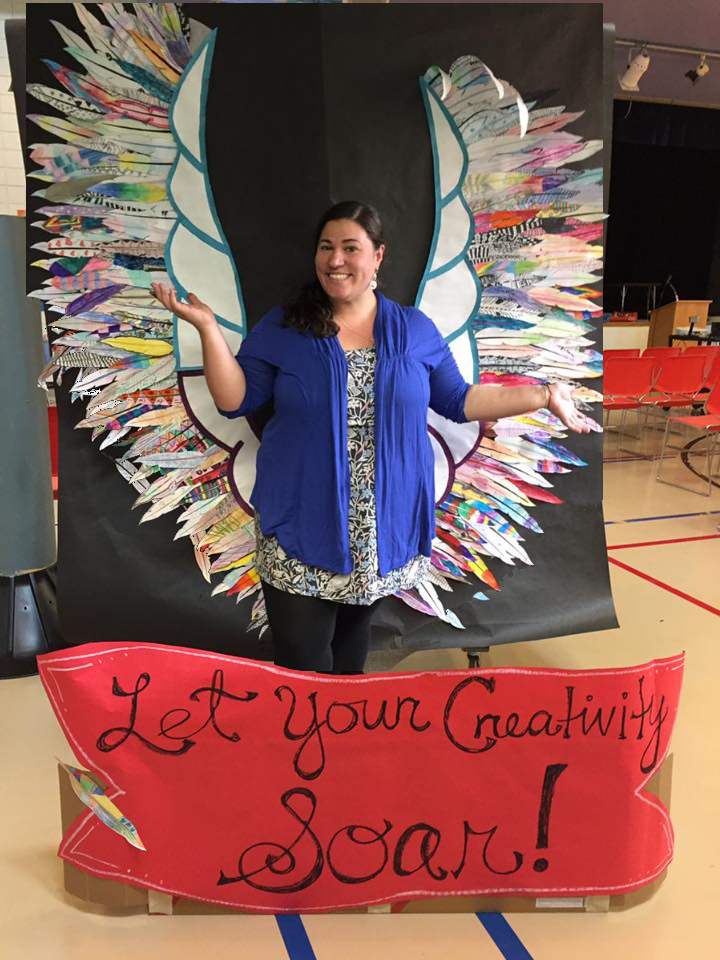
Meet Carly Smith, Art and Technology Teacher at Oak Ridge School. Carly fuses creativity and innovation together every day with her students to program robots, create stop-motion animations, and design in Fab@School Maker Studio.
Can you share a bit about your school and your teaching journey?
I am lucky enough to teach in the elementary school that I attended as a child, so working here feels like coming home. I am in my 8th year at this school and have worn many different hats, from special education teacher to technology integrationist and my current role as a specialist teacher teaching both art and technology. A typical day is never typical! Each day is different and that’s what I like most about my role. My technology classes are working on building computational thinking skills by coding robots so my morning is lots of troubleshooting and runaway robots. My art classes are operating on a choice-based curriculum so in the afternoon I feel like a “creativity coach” teaching mini-lessons, managing the space, and meeting with student-artists.
How are your students using Fab@School Maker Studio?
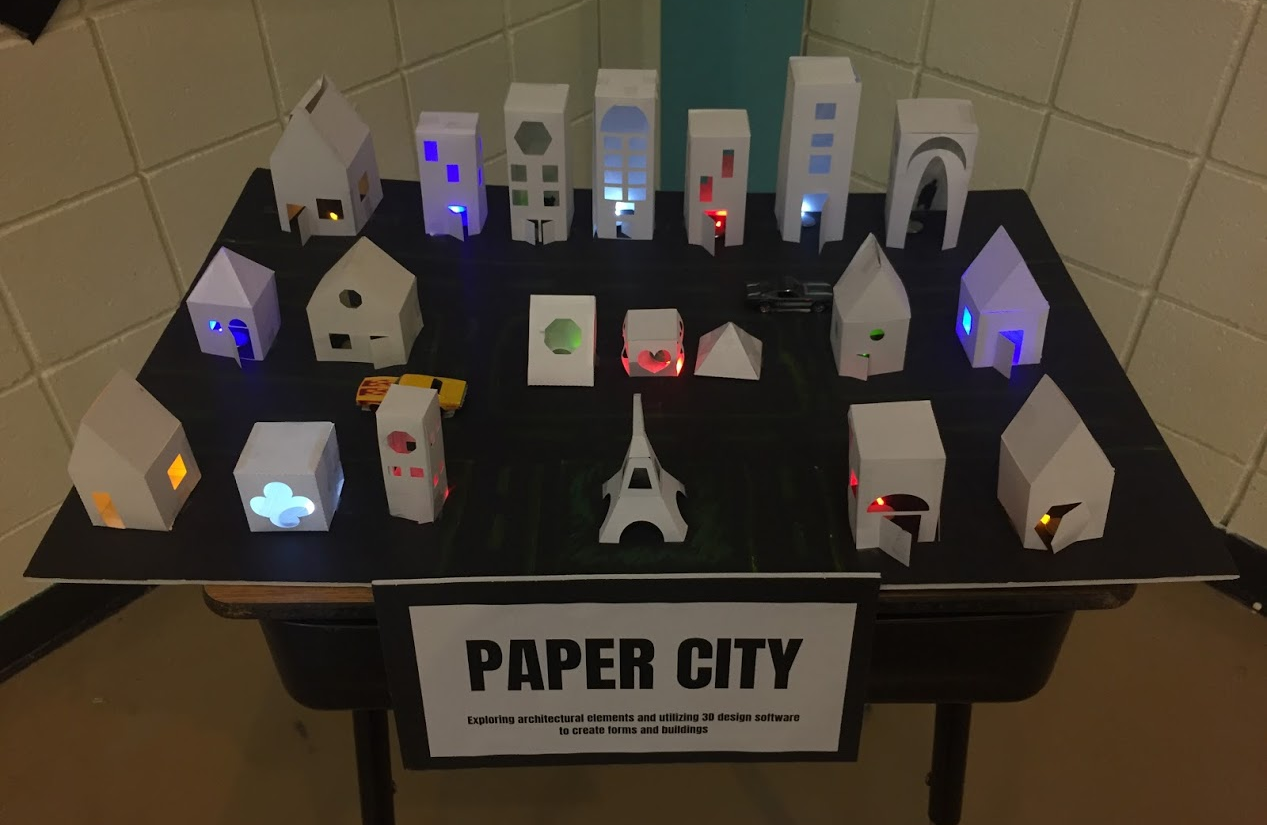
My students used Fab@School Maker Studio to create houses as part of an architecture project we did last year in art class. We looked at different types of buildings and the students designed their own to become part of a “Paper City." They created everything from monuments, to tent camping sites, to skyscrapers and one student even recreated the Eiffel Tower! After the buildings were fabricated the students used LEDs and coin cell batteries to light up the city. After this first project, some students used the software again to create stencils for an apparel design screenprinting project.
What has been the “aha” moment?
I discovered Fab@School Maker Studio at last year’s MassCUE conference. I was so excited the first time I used it because the options are limited only by the imagination of the designer. The software is the perfect combination of “kid-friendly” without being limiting. I had wanted to bring 3D printing into my classroom, but felt that my students’ experience would be diminished due to the expense of the filament and the time the printing takes for each item. Seeing how fast the paper cutter works combined with the affordability of the paper and cardstock made this so doable for my students and me. My PTA generously purchased the licenses and the paper cutter for my classroom and we began using it with Chromebooks last spring.
How are you integrating Fab@School with your current school curriculum?
This year I am hoping to expand the use of the software by having technology classes fabricate “cars” or “boats” that will be driven by the robots we are learning to program. The robots are waterproof so hopefully students will be able to design and program them to drive on dry land or be propelled through water. Check back with me in a few months and we will see how this grand plan comes to life!

As an Art/Tech teacher you really put the A in STEAM- can you share a bit about your role at Oak Ridge and how you incorporate arts with technology?
I am always looking for new ways to incorporate technology into the art curriculum and vice versa. The technology and art curriculums overlap in so many ways because creative problem solving and the design process are so critical to both content areas. In addition to the 3D design work they have done with Fab@School Maker Studio, my students have used software to edit photos or create unique compositions, iPads to create digital artwork, and digital cameras to learn about perspective, create illusions in photography as well as stop-motion animation.

This year we are experimenting with green screens to add interesting effects to our photos and videos. I find that my job is evolving to the point where I am putting students in the driver’s seat and empowering them to come up with ways to creatively use the technology available to them. I try to learn as much as I can about each tool or device so that I can help to guide them and troubleshoot problems. Often students know what they want the technology to do, and just need help getting there. Experimentation can sometimes feel scary because the teacher has to give up control, but the results are usually far beyond what I would have thought of or expected!
What is next?
I am excited to continue to connect with educators who are using this software because the sharing of ideas is so valuable. I would love to add a second printer so that more students can fabricate within a single class period (wish list item!). I am also open to bringing the software to other teachers in my district as part of a possible makerspace to be built. With this and other technology tools I will continue to be inspired by the creativity of my students!

Get Involved
Is your classroom a FabClassroom? We would love to feature your school in a blog post! To be featured in an upcoming post, send an email to info@fablevisionlearning.com. You can also share your Fab@School Maker Studio creations and ideas on social media with #FabMakerStudio! For more posts featuring Fab@School Maker Studio, click here.
But Wait, There's More!
Want to learn more about Fab@School? Fill out the contact form below and a FableVision Team member will get back to you.